
The Comprehensive Guide to Clinical Trial Phases: From Phase 1 to Post-Marketing Surveillance

The Comprehensive Guide to Clinical Trial Phases: From Phase 1 to Post-Marketing Surveillance
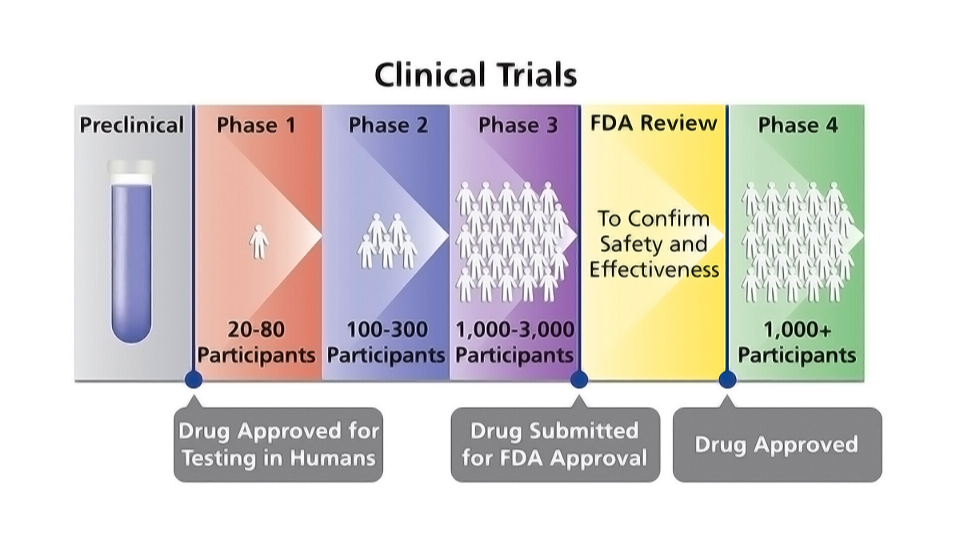
Clinical trials are scientific research processes conducted to develop and evaluate new medications, treatments, medical devices, etc., adhering to regulatory guidelines from health authorities. This proess is very long and complicated but generally, it is comprised of 5 phases.(pre-clinical, Phase 1~3, Phase 4(PMS)) Today, we will look through characteritstics of whol phases.
Pre-clinical trial phase
Typically, a clinical trial consists of a preliminary pre-phase followed by four distinct phases. Although not obligatory, companies in the pharmaceutical or medical sectors often conduct preliminary pre-clinical trials to determine which drug demonstrates optimal pharmacokinetic parameters in humans or animals. These initial trials involve animals or a limited number of participants, typically up to 10 individuals. Should the outcomes align with anticipated effects, subsequent phases, starting with Phase I, may proceed.
Phase 1
Phase I (pharmacology phase) is the smallest phase in clinical trials, wherein researchers determine the pharmacokinetic and pharmacodynamic parameters of new drug candidates. Only a few patients participate in this phase (up to 50), as researchers aim to identify safe dosages (how much of the drug is safe) and treatment solutions (how to optimize treatments for maximum effectiveness), while continuously evaluating the vital signs of patients and monitoring them for side effects. If the dosage safety and efficacy is approved, the new treatment can continue to the next phase (Phase II).
This phase is also known as "dose-escalation" or "human pharmacology" studies, represent the initial examination of the new investigational agent in human subjects. These trials typically involve a small group of "healthy" and/or "diseased" volunteers and are commonly conducted in an open-label manner. The Maximum Tolerated Dose (MTD), which is the highest dose of the drug before encountering dose-limiting toxicity, can be identified through various statistical approaches. Dose escalation adheres to rigorous criteria, and participants are closely monitored for signs of drug toxicity throughout a designated timeframe.
Phase 2
In Phase II (Exploratory phase), researchers investigate the safety and efficacy of a drug or treatment; they need to elucidate how drugs affect the human body and determine exactly how the treatment works. A limited number of patients (hundreds) are enrolled for this phase. Phase II trials, also known as "therapeutic exploratory" trials, typically involve a larger cohort compared to Phase I studies and focus on volunteers afflicted with the targeted disease. These trials aim to assess safety, pharmacokinetics, and pharmacodynamics, while also addressing critical queries crucial for planning Phase III trials, such as determining optimal dosages, frequency of doses, routes of administration, and endpoints. Moreover, they may provide initial indications of drug efficacy through various methods: 1) comparison with "historical controls" derived from published case studies or trials establishing the efficacy of standard treatments, 2) exploration of different dosing regimens within the trial, or 3) random assignment of subjects to different arms, including a control arm. However, due to the limited participant pool and primary focus on safety in Phase II trials, their ability to establish efficacy is usually constrained, underscoring the necessity for subsequent Phase III trials. If the results are approved, the advantages and disadvantages of the new method are assessed, and the drugs are ready to pass to the next phase (Phase III).
Phase 3
In Phase III (Confirmatory phase), many participants are required (hundreds to thousands of individuals). Here, new drugs or treatments are compared against currently available treatments to confirm which one best meets the established criteria. Based on previous research indicating the safety and potential efficacy of a drug, a phase III trial may be initiated. This phase of drug evaluation involves a larger and often more diverse group of participants to confirm efficacy and identify and estimate the occurrence of common adverse reactions. However, since phase III trials typically involve no more than 300 to 3000 subjects, they are statistically powered to establish an adverse event rate of no less than 1 in 100 persons. This underscores the importance of phase IV trials in detecting less common adverse drug reactions and is one reason why the FDA typically requires more than one phase III trial to establish drug safety and efficacy.
The most common type of phase III trial is the comparative efficacy trials. It compares the intervention under study with either a standard therapy or a placebo. Even in well-designed placebo-controlled studies, demonstrating a placebo effect, where subjects exposed to an inert substance show unexpected improvements in outcomes compared to historical controls, is not uncommon. Some attribute the placebo effect to an overall improvement in care provided to trial subjects, while others argue that volunteers for a study are typically symptomatic and naturally improve or experience “regression to the mean” as the trial progresses. This underscores the uniqueness of study participants and why a trial may lack external validity. The use of placebos, including surgical placebos (“sham procedures”), has sparked debate; the revised Declaration of Helsinki supports comparative efficacy trials by discouraging the use of drug placebos in favor of controls receiving the “best current” treatment.
Another type of phase III trial, the equivalency trial (or “positive-control study”), aims to determine if the experimental treatment is similar to a chosen comparator within a prespecified margin set by the investigator. Therefore, placebos are almost never included in this study design. As long as differences between the intervention and the comparator remain within the prespecified margin, the intervention is considered equivalent to the comparator. Although the prespecified margin is often based on external evidence, statistical principles, and clinical experience, there is limited guidance on setting acceptable margins. A variant of the equivalency trial, the noninferiority study, seeks to rule out the possibility that the experimental intervention is less effective than the standard treatment by a prespecified margin. Caution must be exercised when interpreting the results of all types of equivalency trials, as they are often incorrectly designed and analyzed as if they were comparative efficacy studies. Such flaws can introduce bias toward the null, resulting in false-negative results in comparative efficacy studies but false-positive results in equivalency trials. It's worth noting that the noninferiority trial is more prone to false-positive results than other study designs.
The chracteritsitic of phase 3 trials is as the randomization, stratification and blinding. Randomization, pioneered by Sir Austin Bradford Hill, ensures unbiased assignment of subjects to treatment arms. Simple randomization assigns subjects irrespective of previous assignments, but may lead to imbalances. Stratification, often combined with randomization, balances study arms based on predetermined characteristics. Blinding minimizes bias in outcome assessment, though challenges exist with certain trial designs and unmasking of participants. Additional strategies like crossover studies enhance study efficiency when applicable. These methods ensure rigor and reliability in phase III trial design, critical for advancing medical knowledge and patient care.
The intention-to-treat analysis is the most common approach used in analyzing phase III trials, where subjects are evaluated based on the intervention arm to which they were randomized, regardless of the treatment received. This preserves randomization, eliminating selection bias, and attributing any differences in outcomes to treatment alone. In contrast, an “as-treated” or “per-protocol” analysis evaluates subjects based on the treatment they actually received, potentially introducing treatment selection bias. Therefore, intention-to-treat analyses are preferred for the primary analysis of randomized controlled trials, ensuring the validity of results.
If these results are acceptable, manufacturers may register a New Drug Application (NDA) and transfer it to the market.
Phase 4
Phase IV (post marketing) is often called as PMS. The newly released drugs are assessed and monitored after marketing to a significant population over several years to evaluate any side effects over the long term. The purpose of phase 4 is that 1) identify less common adverse reactions, and 2) evaluate cost and/or drug effectiveness in diseases, populations, or doses similar to or markedly different from the original study population.
Conclusion
Clinical trials may be challenging, but they are ultimately worthwhile endeavors. If you are interested in specimen analysis within clinical research, please feel free to reach out.
Reference
[1]Tavana, B., & Chen, A. (2022). Determination of Drugs in Clinical Trials: Current Status and Outlook. Sensors (Basel, Switzerland), 22(4), 1592. https://doi.org/10.3390/s22041592
[2]Umscheid, C. A., Margolis, D. J., & Grossman, C. E. (2011). Key concepts of clinical trials: a narrative review. Postgraduate medicine, 123(5), 194–204. https://doi.org/10.3810/pgm.2011.09.2475