
Central labs provide for Antibody Drug Conjugates (ADCs) Development

A central lab for Antibody Drug Conjugates (ADCs) Development
In J.P. Morgan Healthcare Conference 2024, Antibody Drug Conjugates(ADCs) was selected as one of the major growth keywords. ADC has specific targeting ability of monoclonal antibodies(mAbs) so it can kill tumor cells only, minimalzing affecting normal cells. Due to its characteritiscs, a lot of companies ADCs could become the next geneartion anticacner drug so a lot of pharmaceutical companies alreday entered or plan to develop ADCs. Today, we will review the current status of ADCs development.
What is Antibody Drug Conjugates(ADCs)?
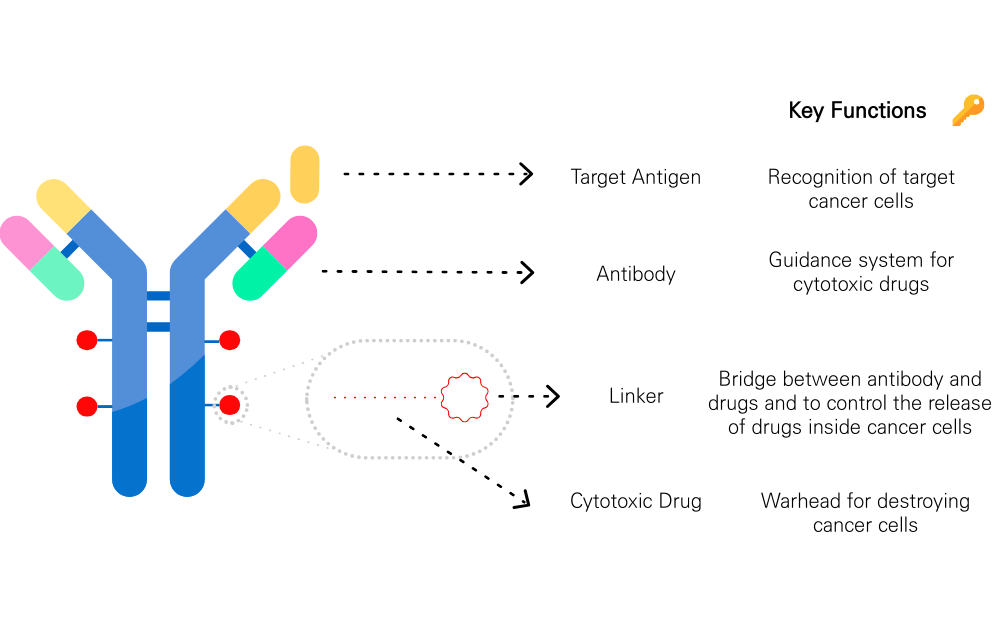
ADCs consist of three major elements: the antibody, the drug and the linker.
The antibody serves as the central component of ADC, primarily determining binding specificity and enabling targeted drug delivery. The drug or payload constitutes the substance to be transported and utilized for manipulating targeted cells, typically comprising cytotoxic agents that induce cell death. However, various alternative payloads have been investigated for their ability to selectively influence specific cells. The third component, the linker, physically links the drug(s) to the antibody, defining the site of drug attachment and the drug to antibody ratio (DAR). Moreover, it can incorporate features such as enhancing hydrophobicity and serum stability or introducing mechanisms for drug release. Each of these elements contributes to shaping the overall characteristics of the assembled molecule.
Differentiated point of ADCs comparing with previous anticancer drugs

Comparing with traditional chemotherapies, ADCs have numerous advantages including: 1) precise delivery of cytotoxic payloads specifically to cells expressing the chosen target antigen, 2) enhanced utilization of potent cytotoxic payloads beyond what can be safely administered systemically, and 3) the potential to reduce on-target/off-tumor toxicity. Successfully designed ADCs hold the promise of widening the therapeutic window compared to systemically administered chemotherapy. By directly transporting cytotoxic payloads to tumor tissue, ADCs can lower the minimum effective dose (MED), thereby reducing adverse events associated with on-target/off-tumor effects.
ADCs based drugs has been aproved
As of 2021, 12 durgs have been approved. The approval process has been accelerated as ADCs became as one of the most likely pillars in the future of oncology. In this review, we examine ADCs that were enrolled in at least one human clinical trial for an oncology indication by January 1, 2023, and were listed in the Beacon Targeted Therapies Clinical Trials and Pipeline Database (beacon-intelligence.com). We focused on ADCs containing two essential components: 1) a targeting moiety, such as an antibody, antibody-fusion, or antibody fragment, and 2) a payload. The payload utilized could be either from a conventional chemotherapeutic class or a targeted small molecule and/or immune-modulator. ADCs incorporating radioisotopes were not included in this analysis.
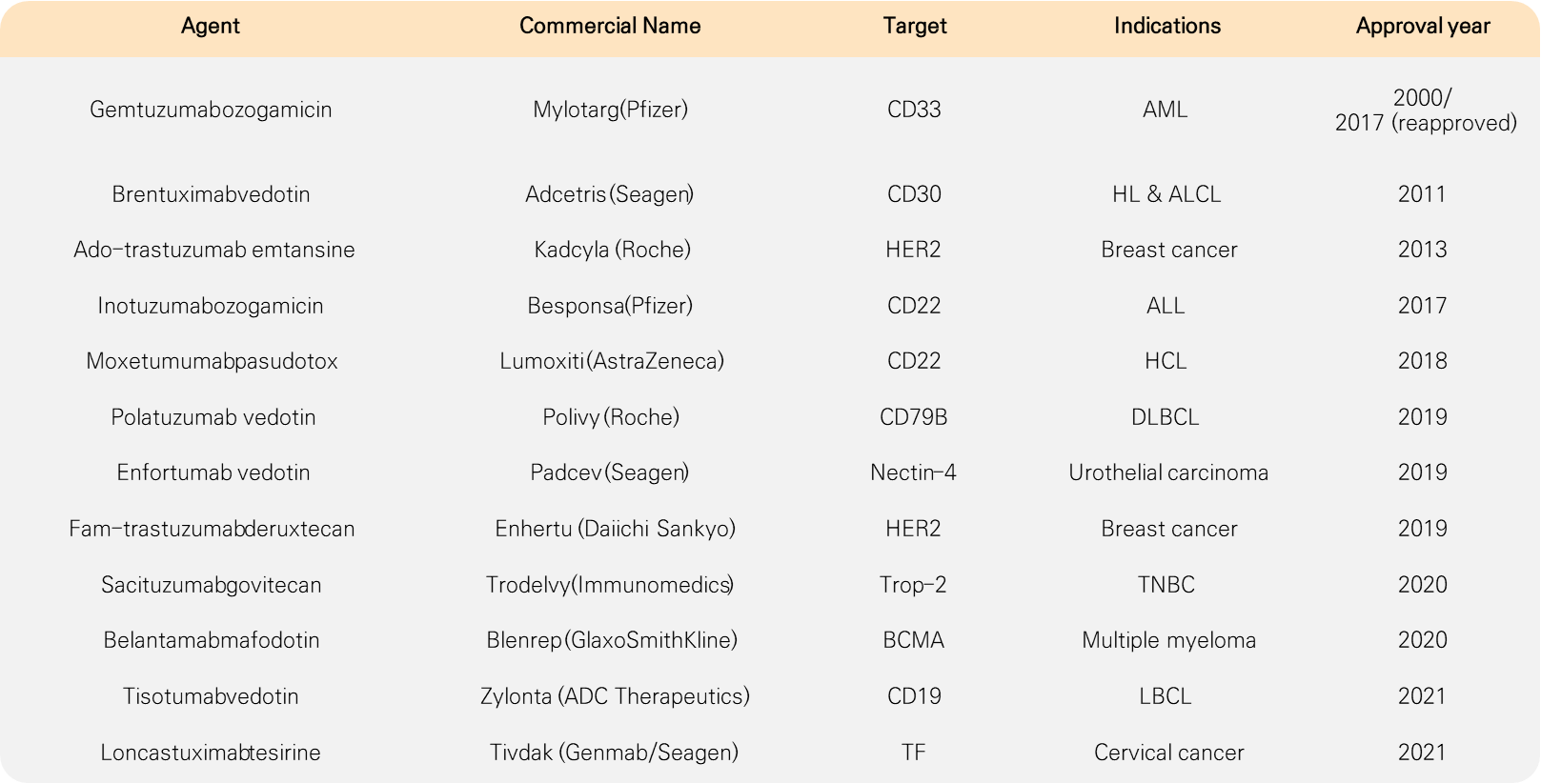
[FDA-approved antibody-drug conjugates(2000~2021)]
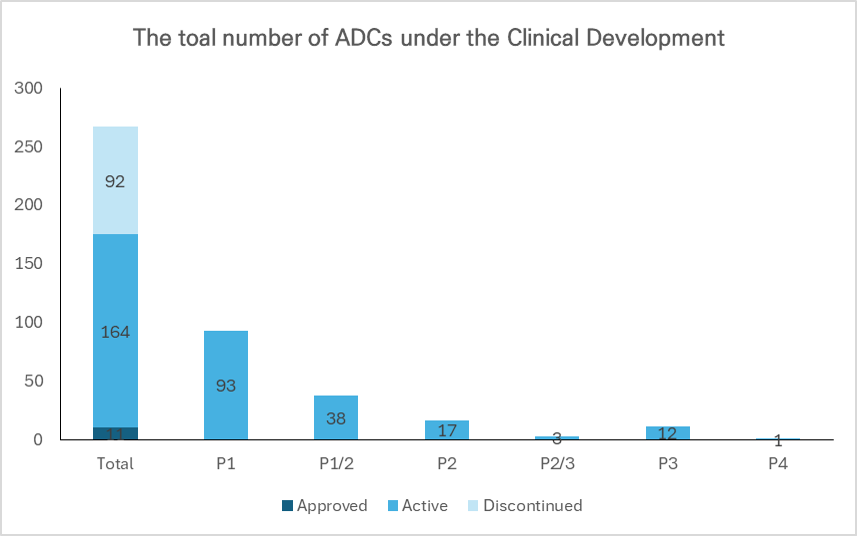
Over the course of 26 years since the first ADC clinical trial in 1997, an additional 266 ADCs have been tested in over 1200 clinical trials. Within this timeframe, 54 ADC programs have been formally terminated, and 38 ADCs have been removed from company pipelines. ADCs discussed in this review are categorized as follows: 1) Approved (by FDA), 2) Active (not FDA-approved but currently in ≥1 clinical trial), and 3) Discontinued (no longer listed in the company’s clinical pipeline, regardless of any discontinuation announcement) [Figure 3]. It's important to note that all Approved ADCs are also currently active in several clinical trials, although they are not included in the ‘Active’ category for the purpose of this review (to avoid duplication). Moreover, all FDA Approved ADCs are approved in other countries besides the United States.
What kind of central lab service would be required for ADCs development?
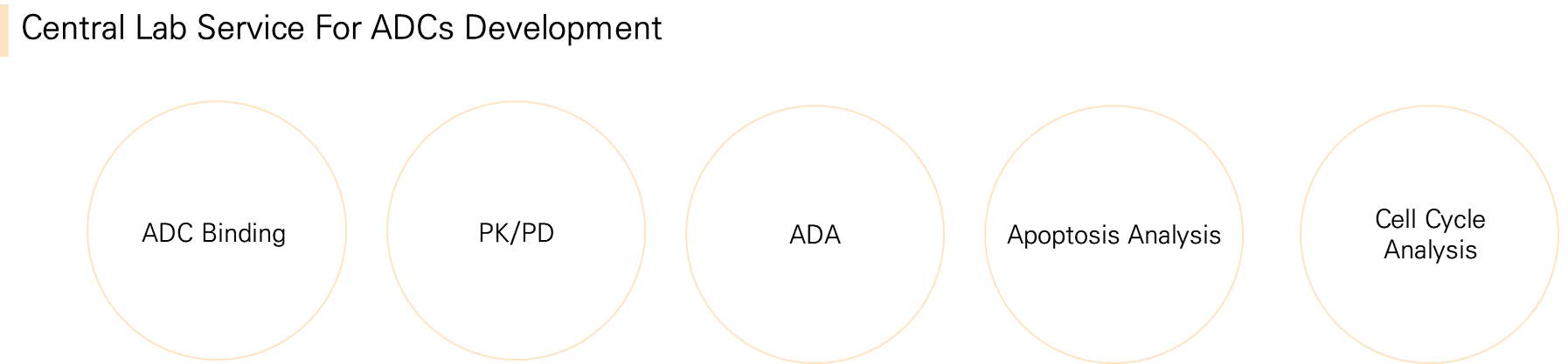
In the development of ADCs, various analytical services are integral at different stages of the process. Here are some essential analytical services:
1.ADC Binding: This entails evaluating the binding affinity and specificity of the ADC to its target antigen. Techniques such as enzyme-linked immunosorbent assay (ELISA), or flow cytometry are typically employed for this purpose.
2.PK/PD Analysis: Pharmacokinetic studies involve the analysis of how the ADC is absorbed, distributed, metabolized, and excreted by the body over time. Pharmacodynamic studies assess the relationship between the concentration of the ADC and its pharmacological effects. Both types of analysis are essential for understanding the drug's behavior in vivo and optimizing dosing regimens. If you would like to learn more, click here.
3.Apoptosis Analysis: Evaluating the induction of apoptosis (programmed cell death) in target cells following exposure to the ADC. Various methods, including flow cytometry using Annexin V/propidium iodide staining or caspase activity assays, can be utilized for this analysis.
4.ADA (Anti-Drug Antibody) Analysis: Detecting and quantifying antibodies generated in response to the administered ADC by the immune system. ADA analysis is crucial for assessing immunogenicity and its potential impact on safety and efficacy.
5.Cell Cycle Analysis: Investigating the effects of the ADC on the cell cycle progression of target cells. Flow cytometry-based assays with DNA staining are commonly employed to analyze different phases of the cell cycle.
These analytical services offer valuable insights into the biological activity, efficacy, and safety profile of ADCs, aiding in their development and optimization for clinical use.
If you are willing to start the conversation with the validatied global central lab, Let's continue the conversation.
Reference
[1]Schwach, J., Abdellatif, M., & Stengl, A. (2022). More than Toxins-Current Prospects in Designing the Next Generation of Antibody Drug Conjugates. Frontiers in bioscience (Landmark edition), 27(8), 240. https://doi.org/10.31083/j.fbl2708240
[2]Maecker, H., Jonnalagadda, V., Bhakta, S., Jammalamadaka, V., & Junutula, J. R. (2023). Exploration of the antibody-drug conjugate clinical landscape. mAbs, 15(1), 2229101. https://doi.org/10.1080/19420862.2023.2229101
[3]Hafeez, U., Parakh, S., Gan, H. K., & Scott, A. M. (2020). Antibody-Drug Conjugates for Cancer Therapy. Molecules (Basel, Switzerland), 25(20), 4764. https://doi.org/10.3390/molecules25204764